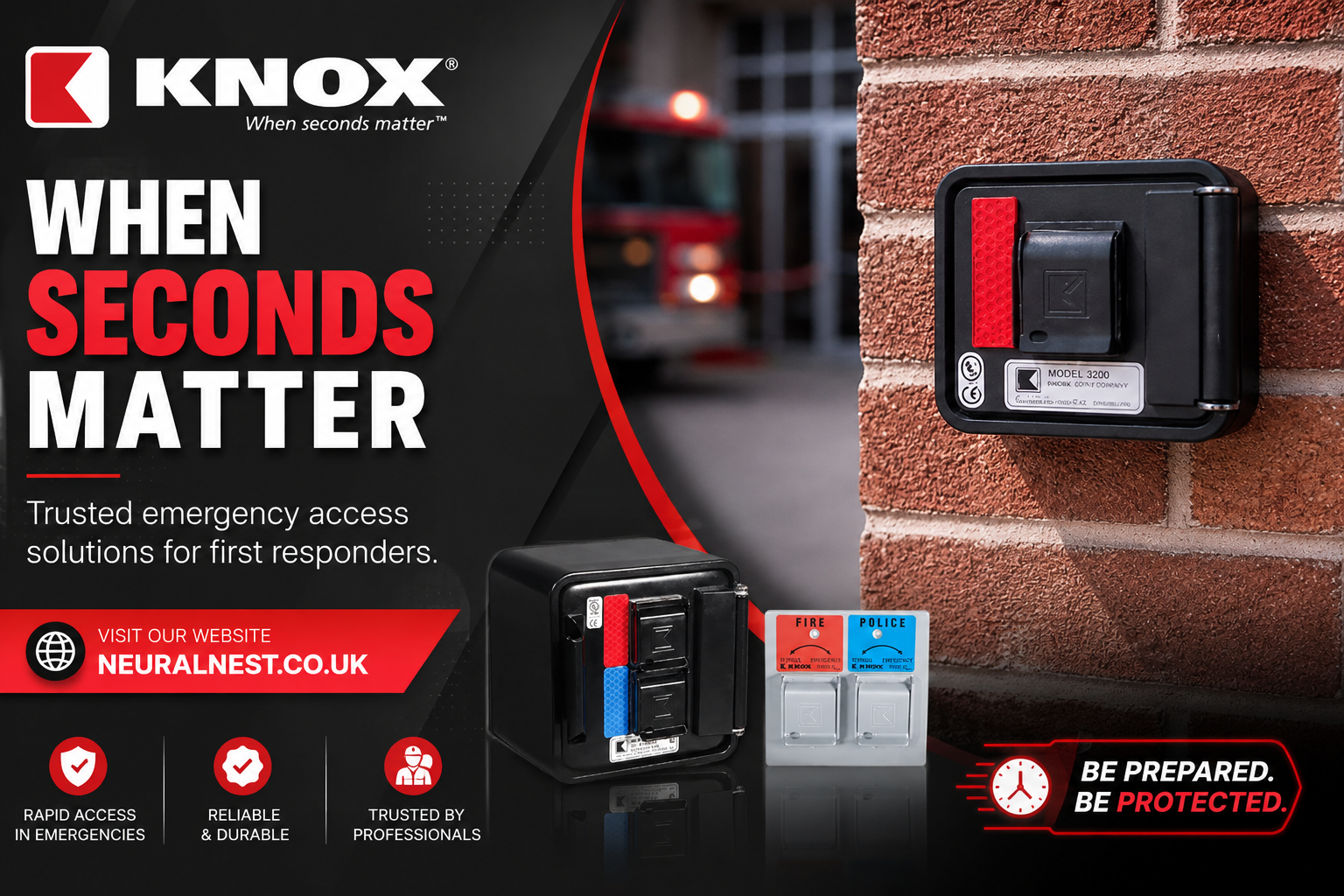

Picture this: a fire alarm goes off at a commercial building at 2 a.m. Firefighters arrive within minutes, but the front doors are locked, there’s no manager on-site, and every second spent forcing entry is a second the fire has to spread. This scenario plays out more often than most property owners realize — and it’s exactly the problem the Knox Box was built to solve.
If you’ve been told your building needs a Knox Box, or you’ve simply seen the small metal box mounted near a commercial entrance and wondered what it does, this guide answers it all: what a Knox Box is used for, how the widely required Knox Box 3200 works, and what property owners need to know before installing one.
What Is a Knox Box?
A Knox Box is a UL-listed key lock box mounted on the exterior of a building that gives fire departments and other authorized emergency responders secure, rapid access to a property without forcing entry. Instead of breaking down a door or window during an emergency, firefighters use a master key — one that only their department holds — to open the Knox Box and retrieve building keys stored inside.
The product is manufactured by the Knox Company, and “Knox Box” has become the generic industry term for fire department rapid entry systems, similar to how “Kleenex” is used generically for facial tissue.
How a Knox Box Works
The system relies on a two-part access model:
- A property owner installs a Knox Box near the building’s main entrance and stores building keys, access cards, or fob credentials inside.
- The local fire department holds a master key (or, in some systems, an electronic credential) that opens every registered Knox Box in its jurisdiction.
Because only the fire department controls the master key, the box remains secure from unauthorized access while still enabling immediate entry when seconds matter.
A Knox Box’s is a UL-listed key lock box mounted outside a building that stores keys for fire department access. Firefighters use a master key exclusive to their department to open it during an emergency, avoiding forced entry and property damage.& more blogs to see Fresh .
What Is a Knox Box Used For?
Fire Department Rapid Entry
The core purpose of a Knox Box’s is emergency access. When an alarm triggers a response and no one is available to let responders in, the Knox Box’s eliminates the delay of forcing a door, cutting a fence, or waiting for a keyholder to arrive.
Reducing Property Damage During Emergencies
Forced entry isn’t free. Doors, frames, security gates, and locks damaged during a forced response often cost property owners more to repair than a Knox Box’s costs to install. By giving responders a legitimate, damage-free way in, the box protects both the building and its contents.
Knox Boxes are also commonly required for:
- Gated communities and apartment complexes (for both fire and EMS access)
- Commercial and industrial buildings with alarm monitoring
- Buildings with restricted access, such as data centers or manufacturing facilities
- Elevator rooms, utility rooms, and fire pump rooms requiring separate rapid entry
Why This Matters
Response time is one of the strongest predictors of outcome in a structure fire — property loss and life-safety risk both increase sharply with every additional minute of delay. A Knox Box’s directly addresses one of the most common and preventable delays: the time spent gaining entry. For property owners, that’s not just a compliance checkbox; it’s a measurable reduction in risk to both the building and to the responders themselves, who face additional danger every time they have to force entry under time pressure.
The Knox Box 3200: Features and Specifications
The Knox Box 3200 is the most widely recognized model in the product line and is frequently the specific unit fire departments reference when they say a building “needs a Knox Box.”
Build Quality and Security Ratings
The 3200 is constructed with a 1/4-inch plate steel housing and a 1/2-inch thick steel door, sealed with an interior gasket and mounted on a stainless steel hinge. Its lock includes a 1/8-inch stainless steel dust cover with tamper-seal mounting capability. The unit carries multiple UL listings, including UL 1037, UL 1610, UL 1332, and UL 437, and is finished with the manufacturer’s proprietary coating, marketed as offering roughly four times the corrosion resistance of standard powder coating.
Key Capacity and Mounting Options
The Knox Box 3200 stores up to 10 keys in its interior compartment. Access cards or small entry items can also be stored, though doing so reduces the maximum key capacity. The surface-mount body measures approximately 4 inches high by 5 inches wide by 3-7/8 inches deep, making it compact enough for mounting near most commercial entrances without obstructing signage or foot traffic.
Property owners are also frequently advised to pair the unit with the Knox Tamper Alert System, which sends a notification if the box is opened or removed from the wall without authorization — an extra layer of security on top of the box’s UL-rated construction.
Knox Box Requirements: Do You Need One?
Knox Box’s requirements are set at the local level, typically by a city or county fire marshal’s office, and vary by jurisdiction. Common triggers for a requirement include:
- A building has a monitored fire alarm system
- A gated property restricts vehicle or pedestrian access
- A building falls under a specific commercial occupancy classification in the local fire code
- A property has previously required forced entry during an emergency response
Because requirements differ, the most reliable first step is always to contact your local fire department or fire marshal’s office directly rather than assuming a generic requirement applies.
How to Get a Knox Box Installed
Step-by-Step Ordering Process
- Contact your local fire department. Confirm whether a Knox Box is required for your property and which model they specify.
- Complete the Knox Company order form, which typically requires fire department authorization before the order is processed — this prevents unauthorized purchases.
- Select your model and mounting style (surface mount is standard for the 3200; recessed and other configurations are available for different needs).
- Arrange professional installation. A licensed contractor, locksmith, or maintenance professional can typically install the unit; some fire departments also offer installation guidance.
- Place your building keys inside and notify the fire department that the box is active and stocked.
- Register for the Tamper Alert System (optional but recommended) for real-time notification if the box is tampered with.
Knox Box Models Compared
| Model | Best For | Key Feature |
|---|---|---|
| Knox Box 3200 | Standard commercial buildings | Most widely required model; UL-rated, 10-key capacity |
| Knox Box 4400 | Larger properties or multiple key sets | Larger interior compartment |
| Knox Vault | High-security or high-value properties | Reinforced, higher-capacity storage |
| Knox Padlock | Gated access points, utility gates | Padlock format instead of wall-mounted box |
| KnoxBox Electronic | Properties needing electronic audit trails | Digital access logging |
Pros and Cons of Installing a Knox Box
| Pros | Cons |
|---|---|
| Eliminates forced-entry property damage | Upfront cost for the unit and installation |
| Speeds up emergency response time | Requires fire department authorization to order |
| UL-listed, tamper-resistant construction | Must be maintained and re-keyed if building locks change |
| Often required for code compliance | Adds a visible security element to a building’s exterior |
| Optional tamper alert adds monitoring | Master key system means trusting the local fire department’s key control |
Expert Recommendations
- Confirm the exact model your jurisdiction requires before ordering. Some departments specify the 3200 exclusively; others accept alternatives.
- Update the box every time locks change. An outdated key inside a Knox Box defeats its entire purpose during an actual emergency.
- Mount it where it’s visible but protected from the elements, ideally near the primary fire department access point to the building.
- Add the Tamper Alert System for high-traffic or high-risk properties. It’s a relatively small additional investment relative to the box itself.
- Keep a maintenance log. Note installation date, last key update, and any inspection visits — useful both for fire marshal audits and insurance documentation.
Mistakes to Avoid With Knox Box Installation and Maintenance
- Ordering a box without first confirming the model and requirements with your local fire department
- Forgetting to update keys inside the box after a rekey or lock replacement
- Mounting the box somewhere obstructed by landscaping, signage, or parked vehicles
- Assuming a Knox Box purchase alone satisfies fire code — some jurisdictions also require specific placement, signage, or registration steps
- Skipping professional installation, which can affect both security and warranty coverage
Conclusion
A Knox Box’s is a small piece of hardware with an outsized impact: it cuts emergency response delays, prevents unnecessary property damage, and is often simply required by local fire code. The Knox Box 3200 remains the industry standard for good reason — UL-rated construction, straightforward installation, and a track record fire departments trust. If you manage a commercial property, a gated community, or any building with a monitored alarm system, checking with your local fire department about Knox Box requirements is a quick call that could matter enormously during an actual emergency.
FAQs
What is a Knox Box used for?
A Knox Box’s is used to give fire departments and other authorized emergency responders secure, rapid access to a building during an emergency, without needing to force open doors, gates, or windows.
What is the Knox Box 3200?
The Knox Box 3200 is the most commonly required Knox Box model, a UL-listed steel key lock box that stores up to 10 keys and mounts on the exterior of a commercial or gated property.
Do I have to buy a Knox Box?
Whether a Knox Box’s is required depends on local fire code and your specific property type; monitored alarm systems, gated properties, and certain commercial occupancies frequently trigger the requirement. Contact your local fire marshal’s office to confirm.
How do I order a Knox Box?
Knox Boxes are ordered directly through the Knox Company, and most orders require authorization from your local fire department before the purchase is processed.
Can anyone open a Knox Box?
No. Only the local fire department (or another authorized emergency responder agency) holds the master key or credential that opens registered Knox Boxes in its jurisdiction.
How much does a Knox Box cost?
Pricing varies by model and accessories such as the Tamper Alert System; property owners should request current pricing directly from the Knox Company or an authorized distributor, since costs can change and vary by configuration.
What’s the difference between a Knox Box and a regular lock box?
A standard lock box is typically opened with a shared code or key accessible to multiple parties, while a Knox Box is a UL-listed, tamper-resistant system opened exclusively by the local fire department’s master key, designed specifically for emergency response rather than general convenience access.
In Short
- A Knox Box is a UL-listed key lock box that gives fire departments rapid, damage-free access to a building during an emergency
- The Knox Box 3200 is the most commonly required model, built with 1/4-inch steel housing and holding up to 10 keys
- Requirements are set locally by fire marshals and commonly apply to monitored alarm systems, gated properties, and certain commercial buildings
- Ordering typically requires fire department authorization before purchase
- Regular maintenance — especially updating keys after a rekey — is essential to keep the system functional
- The Knox Tamper Alert System adds an extra layer of security monitoring for an additional cost