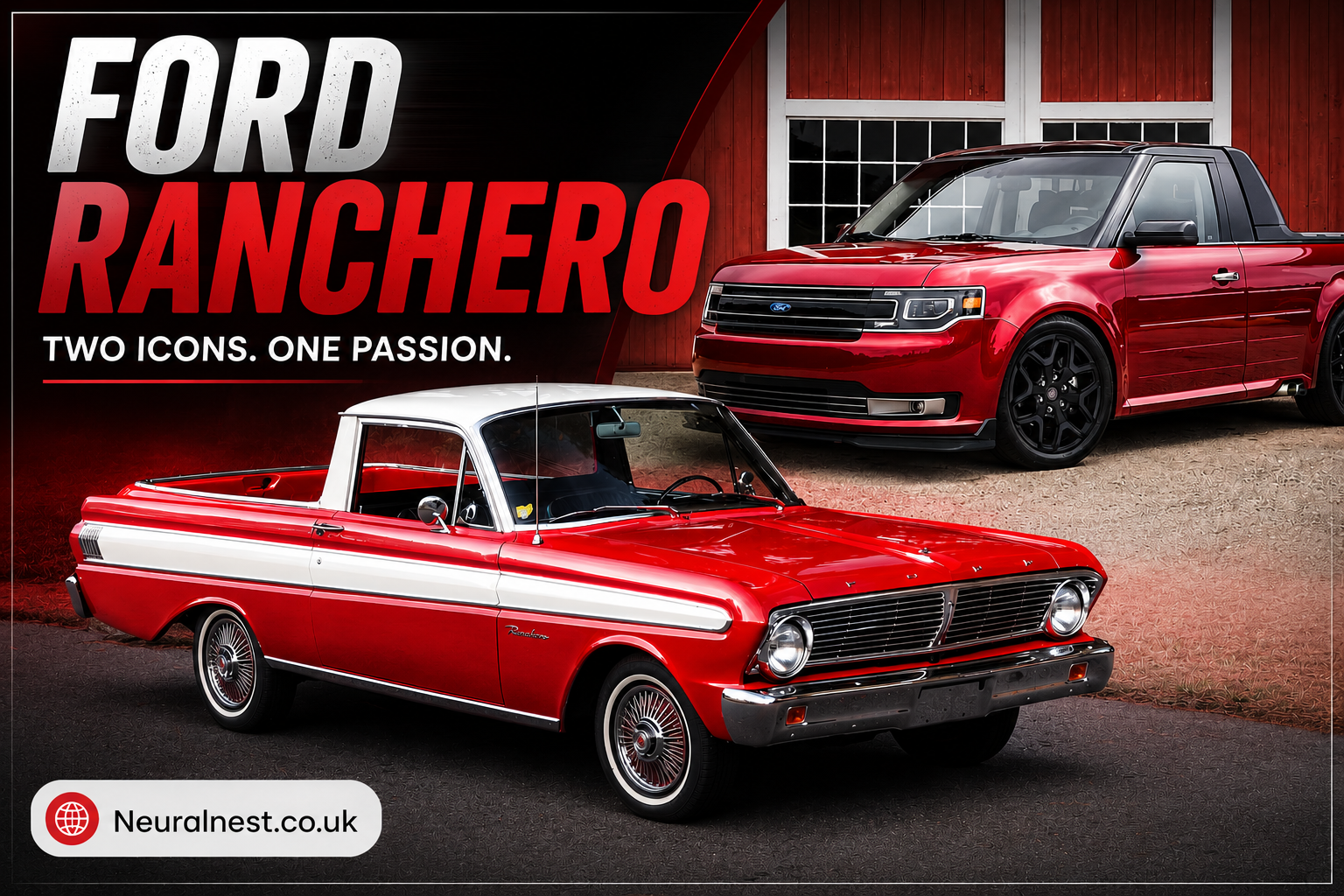

The Ford Ranchero is a car-based pickup — often called a “coupe utility” — that Ford built from 1957 to 1979. It combined a passenger-car chassis and cab with an integrated cargo bed, giving drivers car-like comfort with light-truck usefulness. Ford sold roughly 508,000 units across seven generations before discontinuing the model.
As of August 2026, there is no confirmed new Ford Ranchero on sale. However, Ford has trademarked the Ranchero name and confirmed a low-cost electric pickup — informally dubbed the Ford Ranchero EV by the press — is coming in 2027 as a 2028 model. Ford has not officially confirmed the name will be used on that vehicle.
If you’re shopping for a Ford Ranchero for sale today, you’re looking at the used and classic-car market, where prices range from around $1,000 for project cars to over $100,000 for pristine, high-performance examples.Hero image of a restored 1968–1971 Ranchero GT. “Classic Ford Ranchero GT coupe utility parked outdoors”
The Original Ford Ranchero: A Short History (1957–1979)
Ford launched the Ranchero for the 1957 model year, adapting it from the two-door Ford station wagon platform. The idea was simple but clever: give buyers who needed hauling capacity a vehicle that didn’t feel — or drive — like a work truck. The Ranchero beat its best-known rival, the Chevrolet El Camino, to market by two full years.
Over its 22-year run, the Ranchero was rebuilt on full-size, compact (Falcon), and intermediate (Torino/Fairlane) platforms, adapting to changing consumer tastes and fuel economy pressures throughout the 1960s and 1970s. & more blogs to see digitally .
The Seven Generations at a Glance
| Generation | Model Years | Platform Basis | Notable Trait |
|---|---|---|---|
| 1st Gen | 1957–1959 | Full-size Ford | Original coupe utility design |
| 2nd Gen | 1960–1965 | Falcon (compact) | Smaller, more economical |
| 3rd Gen | 1966–1967 | Fairlane | Mid-size transition |
| 4th Gen | 1968–1969 | Torino | GT trim introduced, big-block V8 available |
| 5th Gen | 1970–1971 | Torino | Peak muscle-truck era |
| 6th Gen | 1972–1976 | Torino/Gran Torino | Larger, softer styling |
| 7th Gen | 1977–1979 | LTD II | Final generation before discontinuation |
Why the Ranchero Mattered
The Ranchero proved there was steady demand for a vehicle that blurred the line between car and truck — a lesson Ford revisited decades later with the Ford Maverick. Its GT variants, especially the 1968–1971 Torino-based trucks, could be ordered with genuine muscle-car V8 power, making them some of the most collectible car-trucks on the market today.
Side-by-side comparison of a 1957 Ranchero and a 1970 Ranchero GT. “Ford Ranchero generations comparison 1957 vs 1970 GT”
Is There a New Ford Ranchero? Separating Fact From Rumor
This is the question driving most searches right now, so let’s be precise about what’s verified and what isn’t.
What Ford Has Actually Confirmed
Ford has confirmed it is building a new, affordable electric pickup as the first vehicle on its Universal EV Platform, a modular architecture designed to underpin everything from compact trucks to three-row SUVs. Ford has stated this truck will:
- Be a four-door, midsize electric pickup
- Be assembled in Louisville, Kentucky
- Target a starting price around $30,000
- Launch in 2027 as an early 2028 model
None of that confirms the Ranchero name.
The Ranchero Trademark Filing, Explained
In August 2025, Ford filed a U.S. trademark application for “Ranchero,” covering automobiles, pickup trucks, and electric vehicles. The application was initially rejected because Ford hadn’t provided an English translation of the Spanish word “Ranchero.” By April 2026, Ford had corrected the filing and secured the trademark in both the United States and Europe.
The timing is suggestive: Ford filed the trademark just days before publicly teasing its “Model T moment” — a reference to the affordable EV platform reveal. That overlap is the main evidence fueling the Ranchero EV rumor.
What’s Still Unconfirmed
Ford has not released:
- A production design or exterior renderings
- Official battery range or towing specifications
- Confirmation that “Ranchero” will actually appear on the vehicle
- A final production price
Automotive outlets note that Ford regularly trademarks names it never uses in production, so healthy skepticism is still warranted until Ford makes an official statement.
Ford Universal EV Platform teaser or Louisville plant photo (if licensed/available). “Ford Universal EV Platform electric truck teaser”
Ford Ranchero EV: Everything Reported So Far
Expected Platform and Build Location
The rumored Ranchero EV would ride on Ford’s new 400-volt Universal EV Platform, engineered with notably fewer components than a traditional EV skateboard — reportedly around 20% fewer parts, 25% fewer fasteners, and 50% fewer cooling hoses and connectors. That simplified engineering is central to hitting an affordable price target.
Expected Price and Timeline
Industry reporting consistently points to:
- Starting price: Roughly $30,000
- Production start: 2027, at the Louisville, Kentucky plant
- Model year: Debuting as a 2028 model
- Estimated range: Around 300 miles, though this figure is a target, not a confirmed EPA rating
How It Compares to the Ford Maverick
The rumored Ranchero EV is widely compared to the Ford Maverick, Ford’s existing compact unibody pickup, because both target buyers who want truck utility without full-size truck pricing or complexity. The key differences reported so far:
| Feature | Ford Maverick (Current) | Rumored Ranchero EV |
|---|---|---|
| Powertrain | Gas, hybrid | Fully electric |
| Platform | C2 unibody | New Universal EV Platform |
| Body style | Two-row, some four-door | Four-door midsize |
| Starting price | ~$28,000+ | ~$30,000 (target) |
| Production | Ongoing | Targeted 2027 |
Ford Maverick vs. rumored Ranchero EV comparison graphic . “Ford Maverick compared to rumored Ford Ranchero EV pickup”
Why This Matters
The Ranchero name carries real brand equity. Ford has already shown, with the Maverick and the F-150 Lightning, that reviving a heritage nameplate on a new platform can generate outsized attention and consumer trust compared to launching an unfamiliar model name from scratch.
If Ford does attach “Ranchero” to its sub-$30,000 electric pickup, it would signal three things for the broader market:
- Affordable EVs are becoming a real priority for legacy automakers, not just a niche experiment.
- Compact, car-based trucks are back in demand, echoing the exact market gap the original Ranchero filled in 1957.
- Heritage naming is now a deliberate EV marketing strategy, following the same playbook Ford used with the Mustang Mach-E and F-150 Lightning.
For shoppers, this matters because it could reshape the affordable EV truck segment — and it explains why searches for “ford ranchero” have spiked even though no new vehicle has been officially unveiled.
Ford Ranchero for Sale: What Classic Models Cost in 2026
If you’re searching “Ford Ranchero for sale” today, you’re shopping the classic and collector market. Based on current listing and sales data:
- Average sale price (all generations): Around $21,000–$23,800
- Entry-level project cars: As low as $1,000–$4,600
- Well-maintained daily drivers: $14,000–$20,000
- Top-condition GT and E-Code models: $30,000 to well over $50,000, with the record public sale reaching $110,000 for a 1957 Ranchero E-Code
Price by Generation
| Generation | Years | Approx. Average Price |
|---|---|---|
| 1st Gen | 1957–1959 | ~$29,000 |
| 2nd Gen | 1960–1965 | ~$17,000 |
| 3rd Gen | 1966–1967 | ~$16,300 |
| 4th Gen | 1968–1969 | ~$14,400 |
| 5th Gen | 1970–1971 | ~$30,500 (GT/muscle demand) |
| 6th–7th Gen | 1972–1979 | Generally lower, high variability |
Prices vary widely based on originality, engine (especially big-block V8s), rust condition, and documented ownership history.
Where to Shop Safely
- Reputable classic car marketplaces and dealers with vehicle history documentation
- Enthusiast clubs and regional car shows, where sellers are easier to vet
- Listings that include recent, dated photos of the VIN plate, frame, and undercarriage
Underside/frame inspection photo of a Ranchero. “Ford Ranchero undercarriage inspection for rust and frame condition”
Pros and Cons of Buying a Classic Ford Ranchero
| Pros | Cons |
|---|---|
| Unique car-truck styling with strong collector appeal | Parts availability can be limited for rare trims |
| Often more affordable than a comparable El Camino | Rust is common in unrestored, unstored examples |
| V8-powered GT models offer genuine performance | Older safety tech (no airbags, basic brakes) |
| Active enthusiast community and parts network | Insurance and financing can be trickier than modern cars |
| Strong long-term value retention on top trims | Daily-driving comfort falls short of modern trucks |
Mistakes to Avoid When Buying a Ford Ranchero
- Skipping a VIN cross-check. Verify the VIN matches across the dash, door, and frame to rule out swapped or reconstructed vehicles.
- Ignoring hidden rust. Fresh paint can mask frame and floorboard corrosion — always inspect underneath, not just the visible body panels.
- Assuming “restored” means “documented.” Ask for receipts, photos, and a paper trail for any claimed restoration work.
- Overpaying based on nostalgia. Cross-check the asking price against recent comparable sales for that specific generation and trim.
- Skipping a pre-purchase inspection. A qualified classic-car mechanic can catch issues a casual walk-around will miss.
- Wiring transaction funds without escrow on high-value deals. Use an escrow service for long-distance purchases over a few thousand dollars.
Expert Recommendations
- If you want a classic Ranchero as a weekend driver: Focus on 4th and 5th generation (1968–1971) models — they offer the best balance of available parts, V8 performance, and collector demand.
- If budget is the priority: 2nd generation (1960–1965) Falcon-based Rancheros typically offer the lowest entry cost with reasonable parts support.
- If you’re waiting on the “new” Ranchero: Treat all 2027/2028 pricing, range, and naming details as targets, not guarantees, until Ford issues an official announcement. Bookmark Ford’s official newsroom rather than relying solely on rumor sites.
- If you’re buying sight-unseen: Always commission a third-party inspection report before wiring any funds.
Conclusion
The Ford Ranchero’s story isn’t finished — it’s just in an unusually public holding pattern. The original coupe utility earned its place in American automotive history between 1957 and 1979, and today’s trademark filings and EV platform confirmations suggest Ford sees real value in that legacy name. But until Ford makes an official announcement, the “new Ranchero” remains an educated guess, not a product.
Whether you’re chasing a restored 1970 Ranchero GT for the weekend or keeping an eye on Ford’s 2027 electric pickup, the smartest move is the same: verify before you buy, and verify before you believe the rumor.
FAQs
Is Ford actually bringing back the Ranchero?
Ford has not officially confirmed a new Ranchero. It has trademarked the name in the U.S. and Europe and confirmed an affordable electric midsize pickup for 2027, but it has not stated that vehicle will carry the Ranchero name.
What is the Ford Ranchero EV?
“Ford Ranchero EV” is the media’s nickname for Ford’s rumored affordable electric pickup, built on the new Universal EV Platform, targeted at around $30,000 and expected in 2027 as a 2028 model. The name is not officially confirmed.
When did the original Ford Ranchero stop being made?
Ford produced the original Ranchero from 1957 to 1979, across seven generations, before discontinuing it in favor of more traditional pickup trucks.
How much does a classic Ford Ranchero cost?
Classic Ford Ranchero prices generally range from about $1,000 for project cars to over $50,000 for pristine or rare GT and E-Code models, with an overall market average in the low $20,000s.
What’s the difference between a Ford Ranchero and a Chevrolet El Camino?
Both are car-based coupe utilities, but the Ranchero launched first, in 1957, two years before the El Camino. They’re often cross-shopped in the classic market, with Rancheros sometimes priced more affordably than comparable El Caminos.
Will the new Ranchero be electric?
If Ford does use the Ranchero name on its upcoming affordable pickup, it would be fully electric, built on the new 400-volt Universal EV Platform rather than a gas or hybrid drivetrain.
Where is the new Ford truck expected to be built?
The rumored Ranchero EV is expected to be assembled at Ford’s plant in Louisville, Kentucky.
In Short
- The original Ford Ranchero was a car-based pickup produced from 1957 to 1979 across seven generations.
- No new Ford Ranchero has been officially confirmed for production as of August 2026.
- Ford has trademarked the “Ranchero” name (U.S. and Europe) and confirmed an affordable electric midsize pickup for 2027, but has not linked the two officially.
- The rumored Ranchero EV would target a ~$30,000 starting price, a Louisville, Kentucky build, and a 2028 model-year launch.
- Classic Ford Ranchero prices today range from roughly $1,000 to over $100,000, averaging in the low $20,000s.
- Buyers should verify VIN, inspect for rust, and request documentation before purchasing a classic Ranchero.