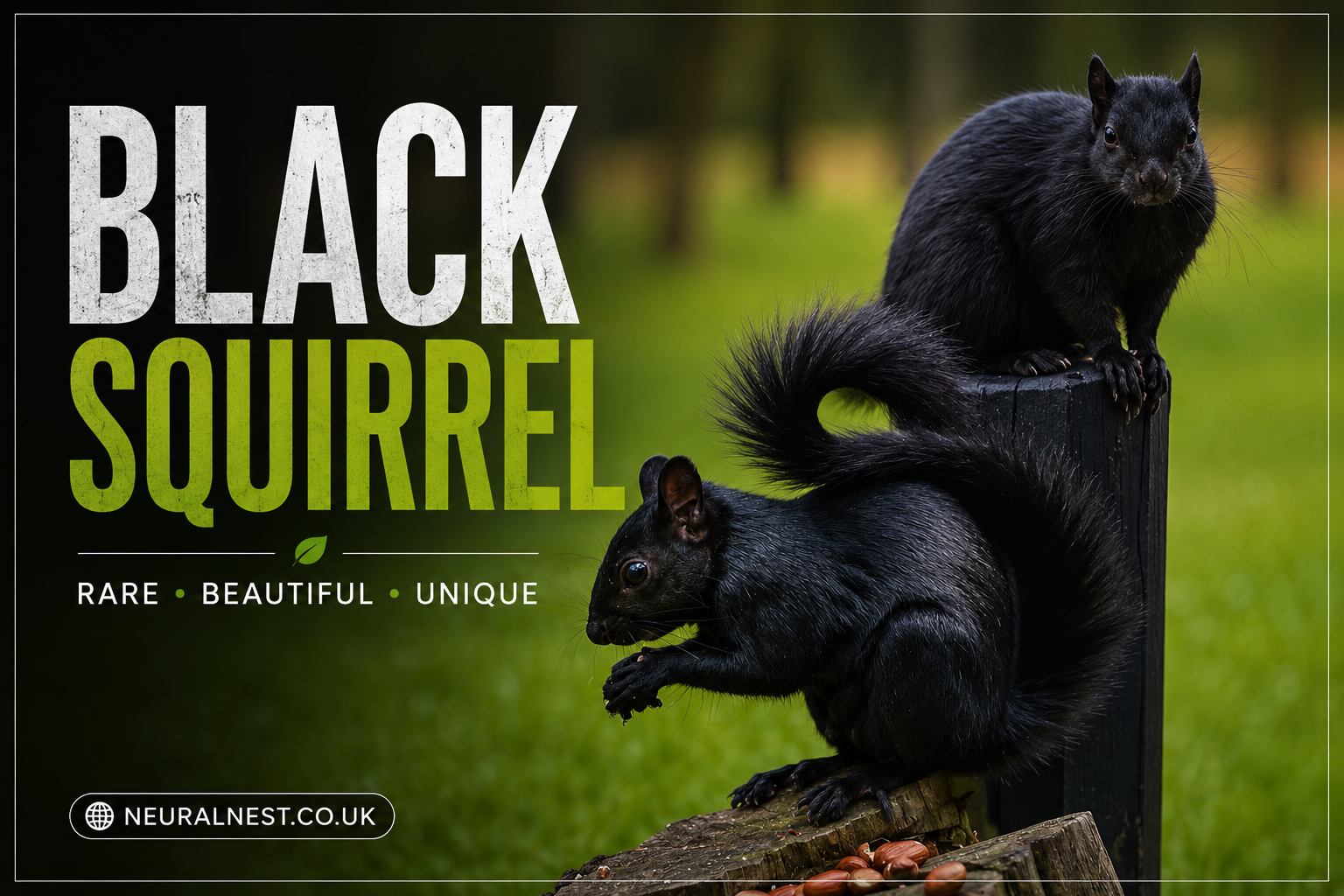

You’re walking through a park and something dark darts across the path — not a cat, not a shadow, but a squirrel, jet black from nose to tail. If you’ve never seen one before, the moment sticks with you. Was that normal? Rare? Does it mean something?
That’s the pain point with black squirrel searches online: the science gets buried under vague folklore, and the folklore gets buried under SEO-stuffed listicles that never actually answer the question. People land on this topic wanting three different things — what a black squirrel actually is, what it’s supposed to symbolize, and (oddly often) where “Black Squirrel” shows up as a place name, like a golf course.
This guide covers all three clearly, separating verified biology from symbolic folklore so you know exactly which is which.
What Is a Black Squirrel?
A black squirrel isn’t a distinct species — it’s a color variant of squirrels that are normally gray or brown, most often the eastern gray squirrel (Sciurus carolinensis) and occasionally the fox squirrel (Sciurus niger). The black coloring comes from melanism, a genetic condition that causes an overproduction of dark pigment (eumelanin), the opposite of albinism.
A black squirrel is not a separate species — it’s a melanistic color variant of the eastern gray squirrel, caused by a genetic mutation that overproduces dark pigment in the fur.
Are Black Squirrels a Separate Species?
No. Genetically, a black squirrel is the same species as the gray squirrels around it — same size, same behavior, same diet. The only real difference is coat color, caused entirely by the underlying gene variant, not by diet, age, or environment.& more blogs to see fresh .
The Genetics Behind Black Fur
Researchers have traced melanism in eastern gray squirrels to a specific mutation in the MC1R gene (melanocortin 1 receptor), known as the MC1RΔ24 allele — a small deletion in the gene’s DNA sequence. This mutation causes the receptor to stay constantly active, which drives ongoing overproduction of dark pigment and overrides the lighter coloring genes.
The trait is incompletely dominant, which explains why black squirrel coats aren’t all identical:
- Two copies of the mutated gene → solid jet-black fur
- One mutated copy, one normal copy → brownish-black or mixed coloring
Scientists estimate black squirrels occur in roughly 1 in 10,000 gray squirrels overall, though that ratio varies enormously by region — in some towns, black squirrels are actually the majority color, not the exception.
Close-up of a black squirrel against green foliage. “black squirrel melanistic eastern gray squirrel”
Where Black Squirrels Are Most Common
Black squirrels aren’t evenly distributed — they cluster heavily in specific regions, largely due to a combination of genetics, historical introductions, and possible cold-weather advantages (darker fur may absorb and retain heat more efficiently in colder climates).
Well-known black squirrel population centers include:
- Kent, Ohio — home to Kent State University’s black squirrel mascot tradition
- Marysville, Kansas — nicknamed the “Black Squirrel City”
- London, Ontario, Canada — one of the most famous concentrations in North America
- Princeton, New Jersey
- Council Bluffs, Iowa
- The broader Great Lakes Basin, including much of Michigan
Black Squirrel Spiritual Meaning
In folklore and spiritual symbolism, black squirrels are commonly associated with transformation, hidden potential, resourcefulness, and adaptability — though these are cultural and symbolic interpretations, not scientific facts.
Common Symbolic Interpretations
Across various spiritual and symbolic traditions, black squirrels have picked up several recurring associations, largely because squirrels in general are already tied to preparation, resourcefulness, and gathering — and black coloring in folklore often carries connotations of mystery or transformation:
- Transformation and change — the rarity and unusual coloring are often read as a sign of a shift or turning point.
- Hidden potential — some interpretations connect the “hidden” black coat (compared to the more common gray) with untapped resources or abilities.
- Resourcefulness and preparation — inherited from general squirrel symbolism around gathering and planning ahead.
- A message to pay closer attention — because black squirrels stand out visually, some spiritual traditions treat a sighting as a nudge to notice something in your environment you might otherwise overlook.
Folklore vs. Fact: What to Keep in Mind
None of these spiritual meanings are scientifically verifiable — they’re cultural and symbolic interpretations, not biological facts, and different traditions and individual writers describe them differently. If you’re drawn to the symbolism, it’s worth treating it the way you’d treat any personal or spiritual reflection: meaningful as a lens for thinking about your own life, not as an empirical claim about the animal itself.
Gray Squirrel vs. Black Squirrel: Quick Comparison
| Category | Gray Squirrel | Black Squirrel |
|---|---|---|
| Species | Eastern gray squirrel (typical coloring) | Same species — melanistic color variant |
| Cause of color | Standard pigmentation | MC1RΔ24 gene mutation (melanism) |
| Rarity | Common, default coloring | Roughly 1 in 10,000 nationally (varies by region) |
| Behavior | Standard squirrel behavior | Identical — no meaningful behavioral difference |
| Possible advantage | Camouflage in typical wooded settings | Possible heat absorption benefit in cold climates |
| Notable populations | Widespread across North America | Concentrated in areas like Kent OH, London ON, Marysville KS |
Black Squirrel Club and Other Namesakes
Black Squirrel Golf Course
If you’ve searched “black squirrel golf course,” you’re most likely looking for Black Squirrel Golf Club in Goshen, Indiana — a public 18-hole course located at 1017 Larimer Dr, built in 1988 and designed by architect Tom Zimmerman. The course plays to a par of 72 across 6,516 yards, with a course rating of 72.2 and a slope rating around 126–133 depending on tee selection. It’s known locally for tree-lined fairways and a welcoming, community atmosphere, and it’s open to the public.
Aerial or fairway shot of a wooded golf course. “black squirrel golf course fairway Goshen Indiana”
Other “Black Squirrel” Named Places
The name shows up repeatedly across the Midwest and Great Lakes region, generally because it’s tied to towns or areas with genuinely visible black squirrel populations. If you’re searching for a specific “Black Squirrel Club” or venue, it’s worth confirming the state and city, since the name is used by multiple unrelated local businesses and recreational spots, not one single national brand.
Why This Matters
Black squirrels sit at a genuinely interesting overlap of hard science and popular folklore, and understanding both sides actually improves the experience of spotting one. Knowing the genetics behind the coloring means you’re not looking at something otherworldly — you’re looking at a specific, well-studied gene mutation working exactly as researchers have documented. At the same time, the cultural weight people give the sighting (rare, symbolic, worth pausing for) is a real and valid part of how humans relate to unusual wildlife, even when it isn’t a scientific claim. Neither side needs to cancel out the other.
Expert Recommendations
- If you’re trying to identify a black squirrel with confidence, look for the same body shape, tail, and size as the gray squirrels nearby — coloring is the only meaningful difference.
- If you’re chasing a sighting for photography, early morning and late afternoon offer the best light contrast against a black coat, which can otherwise photograph as a featureless silhouette in flat midday light.
- If you’re researching local populations, city or university wildlife pages (like Kent State’s, given its mascot tradition) are more reliable sources than general blog posts for confirming whether black squirrels are established in a specific area.
- If the spiritual symbolism resonates with you, treat it as personal reflection rather than fact — plenty of readers find meaning in the coincidence of a sighting without needing it to be scientifically justified.
Mistakes to Avoid When Identifying or Interpreting Black Squirrels
- Assuming a black squirrel is a different species from the gray squirrels around it — it isn’t.
- Treating spiritual or symbolic meanings as established fact rather than folklore and personal interpretation.
- Confusing “Black Squirrel Golf Club” as a single national chain — the name is used by multiple, unrelated local venues.
- Overlooking regional context — a black squirrel is unremarkable in Kent, Ohio, but genuinely rare in most of the country.
Conclusion
A black squirrel is a small thing to stop and stare at, but it turns out to be a genuinely good story — a single gene mutation quietly rewriting a coat color, clustering into whole towns where it’s the norm rather than the exception, while carrying an entirely separate life as a symbol in folklore. Whether you’re drawn to the genetics, the symbolism, or just found this page trying to figure out where that golf course in Indiana actually is, the short version is the same: it’s rare, it’s real, and it’s just a gray squirrel wearing a different coat.
FAQs
What does it mean when you see a black squirrel?
Biologically, it means you’ve spotted a rare melanistic color variant of the eastern gray squirrel. Spiritually, some traditions interpret the sighting as symbolic of transformation, hidden potential, or a nudge to pay closer attention — though this is folklore, not scientific fact.
Are black squirrels rare?
Yes, nationally — they occur in roughly 1 in 10,000 gray squirrels. However, in certain towns like Kent, Ohio, or London, Ontario, black squirrels are common due to concentrated local populations.
Is a black squirrel a different species from a gray squirrel?
No. Black squirrels are typically eastern gray squirrels with a genetic mutation (melanism) that darkens their fur. They’re the same species, just a different color variant.
Why are black squirrels black?
A mutation in the MC1R gene, specifically the MC1RΔ24 deletion, causes overproduction of dark pigment (eumelanin), resulting in black or near-black fur instead of the typical gray coloring.
Where is Black Squirrel Golf Club located?
Black Squirrel Golf Club is a public 18-hole golf course located at 1017 Larimer Dr, Goshen, Indiana, built in 1988.
Do black squirrels behave differently than gray squirrels?
No meaningful behavioral differences have been established beyond coat color — they share the same diet, habitat preferences, and general behavior as gray squirrels of the same species.
In Short
- Black squirrels are not a separate species — they’re a melanistic color variant of the eastern gray squirrel, caused by a mutation in the MC1R gene.
- They occur in roughly 1 in 10,000 gray squirrels nationally, though certain towns have much higher concentrations.
- Spiritual interpretations of black squirrels (transformation, hidden potential) are folklore and personal symbolism, not established fact.
- Black Squirrel Golf Club, a well-known public course tied to the search term, is located in Goshen, Indiana.
- Aside from coat color, black squirrels behave identically to their gray counterparts.