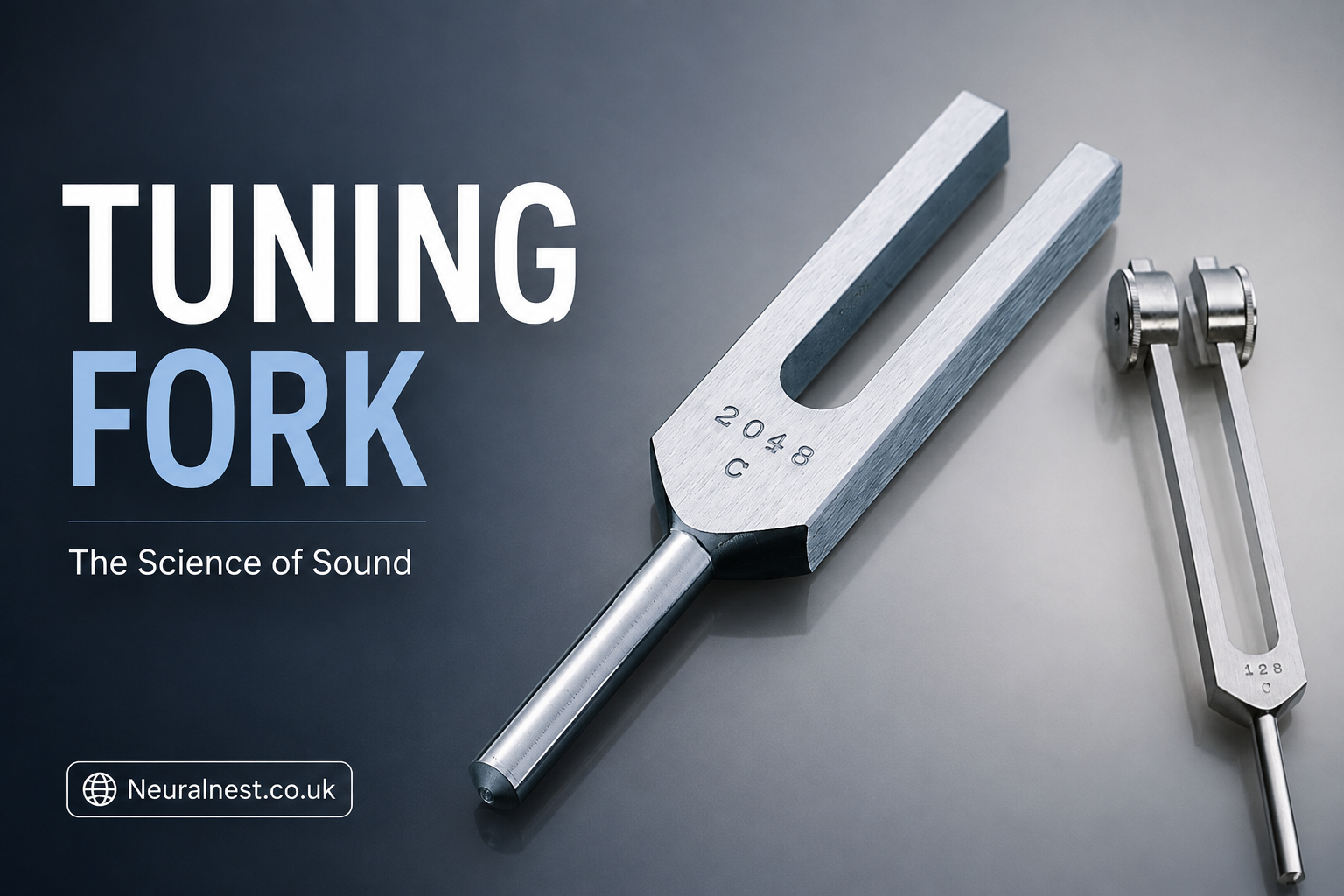

Say “tuning fork” and two very different images come to mind depending on who you ask. A doctor pictures a small metal instrument used in a neurological exam. A wellness practitioner pictures a sound-healing session with forks pressed against pressure points. Both are talking about the same object — and that’s exactly where the confusion starts.
Here’s the pain point: search “tuning fork meaning” or “tuning fork therapy” and you’ll get a flood of claims about frequencies, energy fields, and healing power, with almost nothing distinguishing what’s clinically established from what’s still unproven. If you’re trying to figure out whether a 128 Hz tuning fork is a medical tool, a wellness gadget, or both, you deserve a straight answer.
This guide gives you that — the real history, the confirmed medical uses, an honest look at the evidence behind tuning fork therapy, and practical guidance either way.
What Is a Tuning Fork?
The tuning fork’s is a two-pronged metal instrument that produces a pure, steady tone at a specific pitch when struck. Originally developed in 1711 by British musician John Shore, tuning forks became a standard tool for tuning musical instruments, since the fixed frequency gives a reliable reference pitch that doesn’t drift.
That same reliability — a fixed, predictable vibration — is exactly why the medical field adopted tuning forks in the late 1800s. Physicians noticed the consistent, controllable vibration made it useful for testing a patient’s ability to sense touch and vibration, a use case that has nothing to do with music at all.
Close-up of a metal tuning fork on a plain background.”tuning fork medical instrument close-up” & more blogs to see digital .
Tuning Fork Meaning: Symbolic and Practical Interpretations
A tuning fork’s core meaning is practical: it’s a device that produces a fixed, pure vibration used for musical tuning and medical testing. In wellness and symbolic contexts, it’s also used metaphorically to represent “resonance,” “alignment,” or “balance,” though these are conceptual associations rather than scientific claims.
Outside of its literal function, “tuning fork” has taken on a metaphorical meaning in wellness and self-help language — being “in tune,” finding your “resonant frequency,” or restoring “balance.” This metaphorical use borrows the physics concept of resonance (when one vibrating object causes another nearby object to vibrate at the same frequency) and applies it loosely to ideas about mood, energy, or wellbeing.
It’s worth being clear about the distinction: the physics of resonance is real and well understood. Its application to human emotional or energetic “balance” is a metaphor, not a measurable physical process — a distinction that matters as we get into tuning fork therapy below.
The 128 Hz Tuning Fork in Medicine
How Vibration Sense Testing Works
The 128 Hz tuning fork’s is the standard clinical tool for testing vibratory sensation, a routine part of neurological examinations. A clinician strikes the fork against a firm, non-damping surface (often the heel of the hand), then places the vibrating base against a bony area of the patient’s body — commonly the big toe, ankle bone, or finger joint. The patient reports when they can no longer feel the vibration, and the duration of perceived vibration helps assess nerve function.
This test is especially useful for detecting peripheral neuropathy, including diabetic peripheral neuropathy, where reduced vibration sense in the feet is often an early warning sign. Studies evaluating the 128 Hz tuning fork against more advanced quantitative tools have found it remains a useful, low-cost screening method, even as newer graduated tools like the 64 Hz Rydel-Seiffer fork gain popularity for more precise, standardized measurement in clinical trials.
Why 128 Hz Specifically?
There’s no single scientific reason 128 Hz outperforms every other frequency — but it became the accepted clinical standard because it produces a vibration that’s easy to sense at bony prominences and lasts long enough for a reliable, repeatable exam. A 512 Hz fork, by contrast, is typically used for hearing tests (like the Weber and Rinne tests) rather than vibration sense, since higher frequencies work better for assessing air and bone conduction of sound.
Tuning Fork Therapy: What It Claims and What Evidence Shows
How Tuning Fork Therapy Is Practiced
Tuning fork’s therapy (sometimes called sound healing, biofield tuning, or acutonics) is a complementary wellness practice, not a form of conventional medicine. Practitioners strike a tuning fork and place it against the body, near the ears, or hold it above specific points, often described in terms borrowed from acupuncture meridians or chakra systems.
Proponents describe the mechanism in terms of “resonance” and “entrainment” — the idea that introducing a steady external vibration can help the body’s own systems shift toward a calmer or more balanced state, often citing effects on the autonomic nervous system (the shift from a stressed “fight or flight” state toward a relaxed “rest and digest” state).
What the Research Actually Says
This is where it’s important to separate confirmed uses from claims still under investigation:
- Confirmed: Tuning forks are validated, standard tools for vibration sense testing and certain hearing tests in conventional medicine.
- Preliminary/limited evidence: Some small studies on sound-based relaxation practices — including sound meditation using tuning forks and singing bowls — have reported short-term reductions in reported tension, fatigue, and mood disturbance after a single session. These are generally small studies, and researchers in this space consistently note that findings should be treated as preliminary rather than conclusive.
- Not supported by current evidence: Specific claims about tuning forks correcting a “biofield,” clearing “energetic blockages,” triggering DNA repair, or treating chronic or serious medical conditions are not supported by robust clinical evidence. Reviews in this space consistently caution against using tuning fork therapy as a replacement for conventional medical treatment for serious conditions.
Current evidence for tuning fork therapy is limited. Some small studies suggest short-term relaxation and mood benefits from sound-based practices, but claims about energy fields, cellular repair, or curing medical conditions are not supported by robust scientific research.
Pros and Cons of Tuning Fork Therapy
| Pros | Cons |
|---|---|
| Non-invasive, generally low-risk as a relaxation practice | Not a substitute for medical diagnosis or treatment |
| May support relaxation as a complementary wellness tool | Broader energy/healing claims lack strong scientific support |
| Accessible and easy to try at home with basic guidance | Marketing language often overstates what evidence actually shows |
| No known major side effects for healthy adults | Evidence base remains small and largely preliminary |
Medical Tuning Fork vs. Sound Healing Tuning Fork: Quick Comparison
| Category | Medical Tuning Fork (128 Hz) | Sound Healing Tuning Fork |
|---|---|---|
| Primary use | Vibration sense and hearing testing | Relaxation, wellness, symbolic “energy work” |
| Setting | Clinical exam, hospital, physical therapy | Wellness studios, home use, alternative medicine practices |
| Evidence base | Well-established diagnostic tool | Limited, preliminary evidence for relaxation effects |
| Frequency used | Standardized at 128 Hz (occasionally 512 Hz for hearing) | Varies widely — 136.1 Hz, 432 Hz, 528 Hz, and others, often based on non-clinical traditions |
| Claims made | Assesses nerve and hearing function | Ranges from relaxation support to unproven energy/healing claims |
Why This Matters
Understanding this distinction matters because the same object — a tuning fork — is being marketed in two very different contexts with very different levels of evidence behind them. A patient relying on 128 Hz vibration testing during a diabetic neuropathy screening is participating in an established clinical practice with decades of research behind it. A person buying a “528 Hz love frequency” fork for energy healing is engaging in a wellness practice with a much thinner evidence base — which is fine as a personal relaxation tool, but shouldn’t be mistaken for medical treatment.
Expert Recommendations
- For medical concerns like numbness, tingling, or suspected nerve damage, see a licensed healthcare provider for a proper vibration sense exam and full neurological workup — don’t rely on a home tuning fork kit for diagnosis.
- If you’re curious about tuning fork therapy for relaxation, approach it the way you would meditation or a massage — a complementary practice that may support stress relief, not a treatment for a diagnosed medical condition.
- Be skeptical of specific numeric frequency claims (like a single frequency claimed to trigger “DNA repair” or “cellular regeneration”) — these claims consistently outpace the actual research behind them.
- If you already take conventional medical treatment for a chronic condition, don’t substitute tuning fork therapy for it — most credible sources in this space explicitly frame it as complementary, not a replacement.
Mistakes to Avoid With Tuning Forks
- Using a “sound healing” tuning fork session as a substitute for a real medical evaluation of nerve symptoms.
- Assuming every frequency-specific claim (432 Hz, 528 Hz, etc.) has scientific backing — most are rooted in tradition or marketing rather than peer-reviewed evidence.
- Confusing the well-established medical use of the 128 Hz tuning fork with the far less evidenced claims made in some sound-healing marketing.
- Striking a tuning fork on a hard, damping surface (like a table edge) rather than the heel of the hand or a rubber mallet, which shortens and distorts the vibration.
Conclusion
The tuning fork’s turns out to live a genuine double life — one version standing on decades of clinical validation as a neuropathy screening tool, the other riding on far thinner evidence as a wellness practice. Both are real uses of the same simple object, but they don’t deserve equal confidence. If a doctor reaches for a 128 Hz fork during your exam, that’s established medicine. If a practitioner offers you a “528 Hz” session for energy healing, that’s a relaxation practice worth trying with realistic expectations — not a substitute for care you actually need.
FAQs
What is the meaning of a tuning fork?
Practically, a tuning fork’s is a device that produces a fixed, pure vibration for musical tuning and clinical testing. In wellness contexts, it’s also used metaphorically to represent concepts like resonance, alignment, or balance.
What is a 128 Hz tuning fork used for?
It’s the standard clinical tool used to test vibratory sensation during neurological exams, often to screen for peripheral neuropathy, including diabetic neuropathy.
Does tuning fork therapy actually work?
Evidence is limited. Some small studies suggest short-term relaxation and mood benefits from sound-based practices, but broader healing claims — like correcting an “energy field” or repairing cells — are not supported by strong scientific evidence.
Is a tuning fork used in hospitals?
Yes. Tuning forks, typically 128 Hz or 512 Hz, are standard tools in clinical settings for vibration sense testing and certain hearing tests like the Weber and Rinne tests.
What frequency tuning fork is used for hearing tests?
512 Hz is commonly used for hearing assessments, while 128 Hz is the standard for vibration sense testing.
Can tuning fork therapy replace medical treatment?
No. Most credible sources describe tuning fork therapy as a complementary wellness practice, not a substitute for diagnosis or treatment of medical conditions.
In Short
- A tuning fork produces a fixed, pure vibration, originally developed for musical tuning and later adopted for medical testing.
- The 128 Hz tuning fork is a well-established clinical tool for vibration sense testing, especially for screening peripheral neuropathy.
- Tuning fork therapy (sound healing) has limited, preliminary evidence for short-term relaxation benefits, but broader energy and healing claims lack strong scientific support.
- It’s important to distinguish the clinically validated medical use of tuning forks from wellness marketing claims that outpace current research.
- Tuning fork therapy should be treated as complementary, not a replacement for conventional medical care.