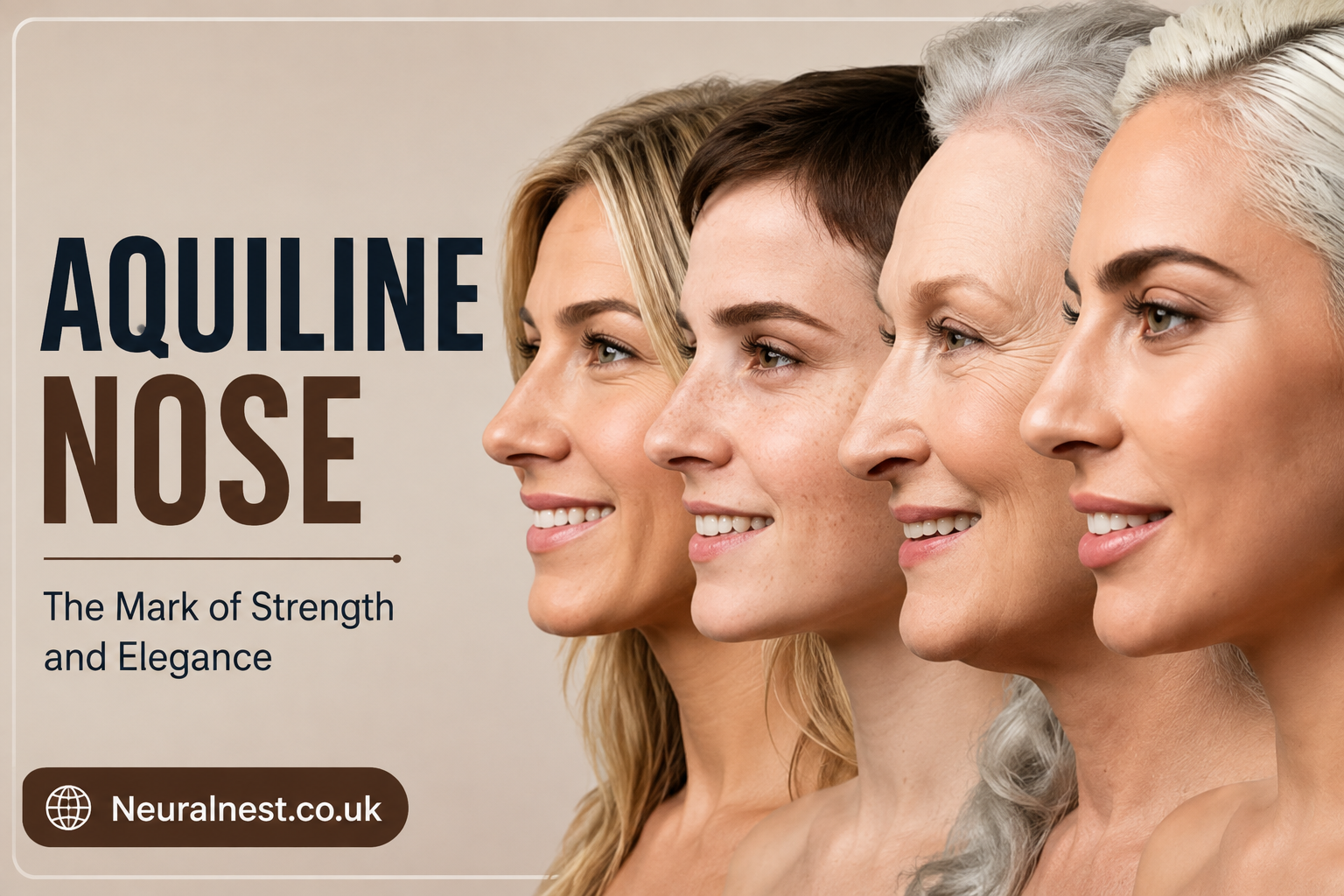

Ever caught your side profile in a photo and thought, “Wait — is that a hook, a bump, or something else entirely?” You’re not imagining things. And you’re definitely not alone in wondering what to call it.
The aquiline nose is one of the most talked-about — and most misunderstood — nose shapes out there. It’s praised in art history, debated in beauty forums, and constantly confused with the “Roman nose.” If you’ve ever searched “aquiline nose vs Roman nose” and come away more confused than when you started, that’s because most articles use the terms interchangeably without explaining what actually sets them apart.
This guide clears it up for good. You’ll learn exactly what an aquiline nose is, how it differs from a Roman nose, where it comes from genetically, how it shows up in women’s facial structure specifically, and which well-known public figures are often cited as having this profile — all without vague generalizations or recycled definitions.
What Is an Aquiline Nose?
An aquiline nose is a nose shape with a prominent, convex bridge that curves downward through the lower third toward the tip, creating a silhouette often compared to an eagle’s beak.
Where the Word “Aquiline” Comes From
The word “aquiline” comes from the Latin aquilinus, meaning “eagle-like” — a direct reference to the curved beak of an eagle. The term has been used in art and anthropology for centuries to describe this distinctive nasal profile, appearing in descriptions of classical sculpture long before it became a modern beauty-forum buzzword. & more blogs to see digital .
Key Physical Traits
An aquiline nose typically shows these characteristics when viewed in profile:
- A raised, prominent bridge
- A convex curve that continues down through the lower portion of the nose
- A tip that curves slightly downward, without fully drooping over the nostrils
- A silhouette that reads as “strong” or “sculpted” from the side
It’s worth noting: “aquiline nose” is a descriptive, aesthetic term — not a formal medical or anatomical classification. Plastic surgeons and researchers use it as shorthand, but there’s no strict clinical measurement that defines exactly where a nose crosses from “straight” into “aquiline.”
Aquiline Nose vs. Roman Nose: What’s the Difference?
This is the single most-searched question on this topic, so let’s settle it clearly.
A Roman nose has a raised bridge with a bump or hump, but the tip stays level or projects forward. An aquiline nose has that same bridge curve, but the curve continues downward all the way to the tip, creating a more pronounced “beak-like” appearance. In everyday conversation, most people use the two terms interchangeably, and that’s generally fine — but the tip is the real distinguishing detail if you want to be precise.
How to Tell Them Apart at a Glance
| Feature | Roman Nose | Aquiline Nose | Hooked Nose |
|---|---|---|---|
| Bridge | Raised, humped | Raised, curved | Raised, sharply curved |
| Tip | Level or forward-projecting | Curves gently downward | Curves strongly, may cover nostrils |
| Overall silhouette | Strong bump, straight finish | Continuous eagle-beak curve | Most pronounced downward curl |
| Common association | Classical Roman statues, strength | Eagle beak, “aquilinus” | Extreme version of the above |
Aquiline vs. Greek vs. Hooked Nose
To round out the picture, here’s how these commonly confused shapes compare:
- Greek nose — a straight bridge with no curve or hump, running in a near-vertical line from forehead to tip.
- Roman/aquiline nose — a convex bridge with a hump or curve, differing mainly in how much that curve continues into the tip.
- Hooked nose — the most exaggerated version, where the downward curve is pronounced enough to visibly droop toward or over the nostrils.
Think of it as a spectrum rather than three totally separate categories: straight → bump with level tip → bump with curved tip → pronounced hook.
What Causes an Aquiline Nose?
Genetics and Heredity
Nose shape — including the aquiline profile — is largely inherited. Cartilage structure, bridge height, and tip projection are passed down through family lines, which is why this feature often runs consistently through generations. In rare cases, a previously straight nose can develop a more aquiline appearance later in life due to an injury that affects the nasal bones or cartilage.
The Truth About Ethnicity and Nose Shape
You’ll often see claims online that the aquiline nose “belongs” to specific ethnic or racial groups. Here’s the more accurate picture: this nose shape appears across many genetically diverse populations worldwide, including Mediterranean, Middle Eastern, South Asian, Andean, and various European groups. Older “racial typology” writings from the early 20th century tried to tie the aquiline nose to specific races and even to personality traits like intelligence or nobility — but modern science does not support any link between nose shape and character, intelligence, or ethnicity in a deterministic sense. It’s simply a common human variation, the same way widow’s peaks or eye color patterns show up across unrelated populations.
The Aquiline Nose in Women: Traits and Styling
An aquiline nose on a woman shows the same core traits described above — a raised bridge with a downward curve toward the tip — but it’s often discussed separately because beauty media has historically pushed narrower, smaller “button nose” ideals for women, which made this stronger profile feel underrepresented for decades.
That’s shifted noticeably in recent years. A defined, aquiline profile is now widely described in beauty and fashion coverage as striking, elegant, and a signature look rather than something to minimize.
Step-by-step styling tips for working with an aquiline nose:
- Contour minimally, don’t over-correct. Light contouring along the sides of the bridge can soften shadows without erasing the shape’s natural structure.
- Choose glasses with attention to bridge height. Frames with a slightly lower bridge point can balance a prominent nasal bridge.
- Play with hairstyles that frame the face. Side-swept bangs or soft layers around the cheekbones can create balance without hiding the profile.
- Highlight the tip subtly. A touch of illuminating product on the tip of the nose (not the bridge) can soften an overly sharp downward curve in photos.
Aquiline Nose Celebrities
Several well-known public figures are frequently cited in beauty and entertainment coverage for having a classic aquiline profile, including Meryl Streep, Barbra Streisand, Angelina Jolie, Adrien Brody, Owen Wilson, and Jared Leto. These examples are commonly referenced specifically because their profile is considered a defining, recognizable part of their overall look rather than a feature they’ve downplayed — which is often cited as evidence that this nose shape reads as striking rather than something to “fix.”
Pros and Cons of an Aquiline Nose Profile
| Pros | Cons |
|---|---|
| Considered distinctive and photogenic in profile shots | Can cast stronger shadows in certain lighting |
| Historically and culturally associated with strong, classical features | Some report difficulty finding well-fitting glasses |
| Increasingly celebrated in modern beauty standards | Subject to outdated stereotypes that deserve pushback |
| Low-maintenance — no special care required | Occasionally targeted by unnecessary self-consciousness driven by outdated beauty norms |
Mistakes to Avoid When Discussing or Styling an Aquiline Nose
- Assuming it’s tied to a single ethnicity. As covered above, this shape appears across many populations — treating it as an ethnic marker is outdated and inaccurate.
- Over-contouring in makeup. Heavy-handed contouring can look unnatural and draw more attention to the bridge, not less.
- Choosing glasses without considering bridge fit. Ill-fitting frames can slide or sit awkwardly on a more prominent bridge.
- Confusing “aquiline” with “hooked” in casual conversation. They’re related but not identical — a hooked nose involves a more pronounced tip droop.
- Treating cosmetic changes as necessary rather than optional. Whether to pursue rhinoplasty is a deeply personal decision, not something that should be driven by outdated beauty pressure.
Why This Matters
Nose shape has carried outsized cultural baggage for centuries — tied at various points to outdated ideas about race, class, and character that have no scientific basis. Understanding what an aquiline nose actually is, in accurate and neutral terms, helps push back against those old stereotypes while giving people clear, useful language for something as simple as describing their own face. It also matters for anyone researching cosmetic procedures: knowing the real anatomical difference between “Roman,” “aquiline,” and “hooked” helps you communicate more precisely with a specialist if you ever choose to.
Expert Recommendations
- Get a professional consultation before assuming anything about surgery. If you’re considering rhinoplasty, a board-certified facial plastic surgeon can explain exactly what your bridge and tip structure allow for — general online descriptions can’t replace that.
- Use side-profile photos, not just frontal ones, to assess your nose shape. Most of what defines “aquiline” versus “Roman” versus “straight” is only visible from the side.
- Don’t chase a specific celebrity’s nose. Facial proportions differ from person to person; a shape that looks striking on one face may not suit another’s proportions the same way.
- If breathing is a concern, mention it explicitly to a doctor. A structural bridge curve is sometimes accompanied by a deviated septum, which is a functional — not just cosmetic — issue worth addressing separately.
- Embrace styling over alteration if you like your profile. Small adjustments in makeup, glasses, and hairstyle can enhance an aquiline nose without any permanent change.
Conclusion
An aquiline nose isn’t just a “hooked” or “big” nose — it’s a specific, well-defined profile shape with a raised bridge and a curve that continues down toward the tip, distinct from both the flatter-tipped Roman nose and the more exaggerated hooked nose. It’s genetic, it shows up across dozens of different populations worldwide, and it has nothing to do with the outdated stereotypes once attached to it. Whether you’re trying to identify your own profile, comparing it to a Roman nose, or just curious why so many celebrities are described this way, the short version is this: it’s a natural, common variation — and increasingly, a celebrated one
If you’re exploring your options — whether that’s makeup techniques, glasses shopping, or a consultation about rhinoplasty — start by getting clear, accurate information rather than relying on outdated beauty myths.
FAQs
What does an aquiline nose look like?
An aquiline nose has a raised, convex bridge that curves downward through the lower third toward the tip, creating a silhouette often compared to an eagle’s beak.
Is an aquiline nose the same as a Roman nose?
They’re closely related and often used interchangeably. The technical difference is the tip: a Roman nose has a bridge hump but a level or forward tip, while an aquiline nose’s curve continues down into the tip itself.
Is an aquiline nose attractive?
Attractiveness is subjective and culturally shaped, but an aquiline nose is widely described in beauty and fashion media as striking, distinctive, and photogenic, and it’s increasingly celebrated rather than considered a flaw.
Is an aquiline nose genetic?
Yes. Nose shape, including the aquiline profile, is primarily inherited through family genetics, though in rare cases an injury can change a nose’s shape later in life.
Is the aquiline nose linked to a specific ethnicity?
No. While it’s commonly seen in Mediterranean, Middle Eastern, South Asian, and some European and Andean populations, it appears across many genetically diverse groups worldwide, and no scientific evidence supports linking it exclusively to any single ethnicity or race.
What celebrities have an aquiline nose?
Public figures frequently cited for a classic aquiline profile include Meryl Streep, Barbra Streisand, Angelina Jolie, Adrien Brody, Owen Wilson, and Jared Leto.
Can you fix an aquiline nose with rhinoplasty?
Yes, rhinoplasty can adjust the bridge height and tip curve of an aquiline nose if someone chooses to pursue it, but many people keep this feature unchanged as it’s considered a defining part of their look. Any decision should start with a consultation with a board-certified facial plastic surgeon.
In Short
- An aquiline nose has a raised, convex bridge with a curve that continues down toward the tip, resembling an eagle’s beak.
- The key difference from a Roman nose is the tip: Roman noses have a level tip, aquiline noses have a curved one.
- Nose shape is primarily genetic and appears across many different populations worldwide — it is not tied to a single ethnicity or personality trait.
- Public figures like Meryl Streep, Angelina Jolie, and Adrien Brody are commonly cited for this profile, reflecting its growing recognition as a striking feature rather than something to correct.
- Whether you choose to style around it or consider cosmetic options, understanding the real terminology helps you make informed, confident decisions.