
You flip over a teacup at an estate sale, or a saucer your grandmother left you, and there it is: a small stamp reading “Bavaria, Western Germany.” No brand name jumps out. No obvious date. Just those two words, sitting quietly on the underside of a piece that might be worth $12 — or considerably more.
That uncertainty is the exact problem this guide solves.
Most articles about German porcelain marks either drown you in manufacturer trivia or skip the one thing collectors actually need: a reliable way to read the mark and place the piece in time. This guide does both. By the end, you’ll know exactly what “bavaria western germany” means, how to use it to date your china or tea set, which makers typically used it, and how to avoid the pricing mistakes that trip up even experienced sellers.
What Does “Bavaria Western Germany” Actually Mean?
Bavaria — The Region, Not the Brand
“Bavaria” is not a manufacturer. It’s the southeastern German state where a dense cluster of porcelain factories operated for over a century — names like Rosenthal, Schumann, Hutschenreuther, and dozens of smaller workshops. When you see “Bavaria” alone on a backstamp, it tells you where the piece was made, not who made it, which is why the same word appears on wildly different quality levels and price points.
“Western Germany” — A Political Label With a Timeline
This is the part most guides get vague on, so let’s be precise.
West Germany refers to the Federal Republic of Germany between its creation on May 23, 1949, and German reunification on October 3, 1990. During that Cold War stretch, the country was split into two states — the Western-aligned Federal Republic and the Soviet-aligned German Democratic Republic — and manufacturers exporting goods needed a way to signal which side of the border their factory sat on. & more blogs fresh .
That’s exactly what the “Western Germany” stamp did. As one collector-forum authority on German marks explains, pieces made for export during this era could be marked either “Western Germany” or simply “Germany,” and the “Western Germany” mark conclusively dates the piece to the 1949–1990 window. A plain “Germany” mark, on the other hand, is far less conclusive — it only confirms manufacture sometime after 1887.
Why This Matters
Getting this mark right isn’t academic — it changes real decisions:
- Valuation accuracy. A piece incorrectly assumed to be pre-war (and therefore “antique” in the 100+ year sense) can be overpriced by a seller and rejected by a knowledgeable buyer, or underpriced by an owner who doesn’t realize a specific decorator or pattern is desirable.
- Insurance and estate appraisals. Family china is frequently listed on estate inventories with guessed ages. A wrong 40-year date swing affects replacement-value calculations.
- Authentication. Reproduction and mislabeled pieces exist. Knowing the expected combination of words, fonts, and colors for a given decade helps you catch inconsistencies.
- Search and resale listings. Buyers on eBay, Etsy, and Chairish search by exact mark wording. Listing your set correctly (“Bavaria Western Germany” vs. “Bavaria West Germany” vs. “Bavaria Germany”) directly affects whether it’s found at all.
In short: the mark is small, but the decisions built on top of it aren’t.
A Short History of the Mark
The Merchandise Marks Act and Early Export Stamps
Germany’s Merchandise Marks Act of 1887 required goods exported abroad to be marked “Germany” or “Made in Germany,” while items sold domestically had no such requirement. This is why so many pieces made for the American and British markets carry a country-of-origin stamp at all — it wasn’t German tradition, it was export law.
Divided Germany (1949–1990) and the Shift to “Western Germany”
Once the country split, exporters needed a mark that distinguished Federal Republic production from East German (GDR) production. Collector research on porcelain decorator marks places the specific wording “WESTERN GERMANY” in use roughly between 1951 and the early-to-mid 1960s, after which factories gradually shifted their phrasing.
When “Western Germany” Became “West Germany,” Then “W. Germany”
Terminology didn’t change overnight, and it didn’t change uniformly. As the same source notes, wording shifted over time from “Western Germany” to “West Germany” and later to “W. Germany,” with each company adopting the change on its own schedule. Notably, a 1973 ruling by Germany’s Federal Court of Justice held that a plain “Made in Germany” stamp no longer adequately distinguished between the two Germanys, pushing “Made in West Germany” into wider popular use from roughly 1973 to 1990.
There’s an important caveat here, and good guides say it plainly: absence of a “Western Germany” or “GDR” mark does not prove a piece is older or from a different country. As one long-time mark researcher puts it, “Germany” alone sets no reliable boundary, because many East German factories kept using the plain word “Germany” right up until a 1972 nationalization wave forced them to switch to “Made in GDR”. Even well-known West German houses varied — Rosenthal, for instance, typically stuck with “Bavaria” and “Germany” rather than adding “West Germany” to its standard marks.
“Western Germany” is a strong, conclusive dating clue when present. Its absence tells you almost nothing on its own.
How to Date a Bavaria Western Germany Piece: Step-by-Step
- Photograph the full mark under good light, including any faint underglaze stamps beneath the printed overglaze mark.
- Read the exact wording. “Western Germany” (1949–early/mid-1960s window), “West Germany” (broadly 1949–1990, more common from the 1970s on), and “W. Germany” (later decades) each narrow the range differently.
- Check for a manufacturer name or monogram. A named maker (Rosenthal, Schumann, Hutschenreuther, Edelstein) lets you cross-reference that specific factory’s own mark timeline, which is more reliable than the generic country wording alone.
- Compare the mark’s color and printing style. Many factories used one design of stamp with slight typographic tweaks year over year — a factory’s own catalog or a specialist mark database can pin this down further.
- Cross-check the pattern. If the piece has a named or numbered pattern, search that pattern name — many were only produced for a specific run of years.
- Weigh the caveat. Treat “Western Germany” as a confident marker of the divided-Germany era, but don’t assume a lack of that wording means pre-war or East German origin.
Common Manufacturers Using Bavaria and Western Germany Marks
| Maker | Region | Typical Mark Style | Notable For |
|---|---|---|---|
| Rosenthal | Bavaria | “Rosenthal, Bavaria, Germany” (rarely added “West Germany”) | High-end tableware, art porcelain |
| Schumann (Carl Schumann / Arzberg) | Bavaria | “Schumann, Bavaria, Germany” or “Western Germany” | Dresden-style florals, gilt tea sets |
| Hutschenreuther | Bavaria | “Hutschenreuther Bavaria” + country line | Dinnerware and figural pieces |
| Edelstein | Bavaria | “Edelstein Bavaria” with era-specific country wording | Mid-century patterns, transfer prints |
| Various unmarked decorators | Bavaria | Decoration-studio monograms with “Western Germany” line only | Hand-applied gilding and transfers |
(This table is illustrative and summarized from general porcelain-mark reference conventions; always verify against a dedicated mark database for a specific piece.)
Bavaria Western Germany vs. Other German China Marks
| Mark Wording | Approximate Era | What It Tells You |
|---|---|---|
| “Germany” only | Post-1887, inconclusive beyond that | Could be pre-war, post-war West, or even East German production |
| “Western Germany” | ~1949–mid-1960s | Conclusively divided-Germany, Federal Republic export |
| “West Germany” | ~1949–1990, more common from 1973 on | Divided-Germany era, later phrasing convention |
| “W. Germany” | Later divided-Germany decades | Same era as above, abbreviated form |
| “Germany, GDR” / “Made in GDR” | Post-1972 in the East | East German (Soviet-aligned) production |
| “Bavaria” (no country word) | Any era, often pre-1949 or domestic-market pieces | Region only — needs another clue to date it |
Bavaria Western Germany Tea Sets: What Collectors Look For
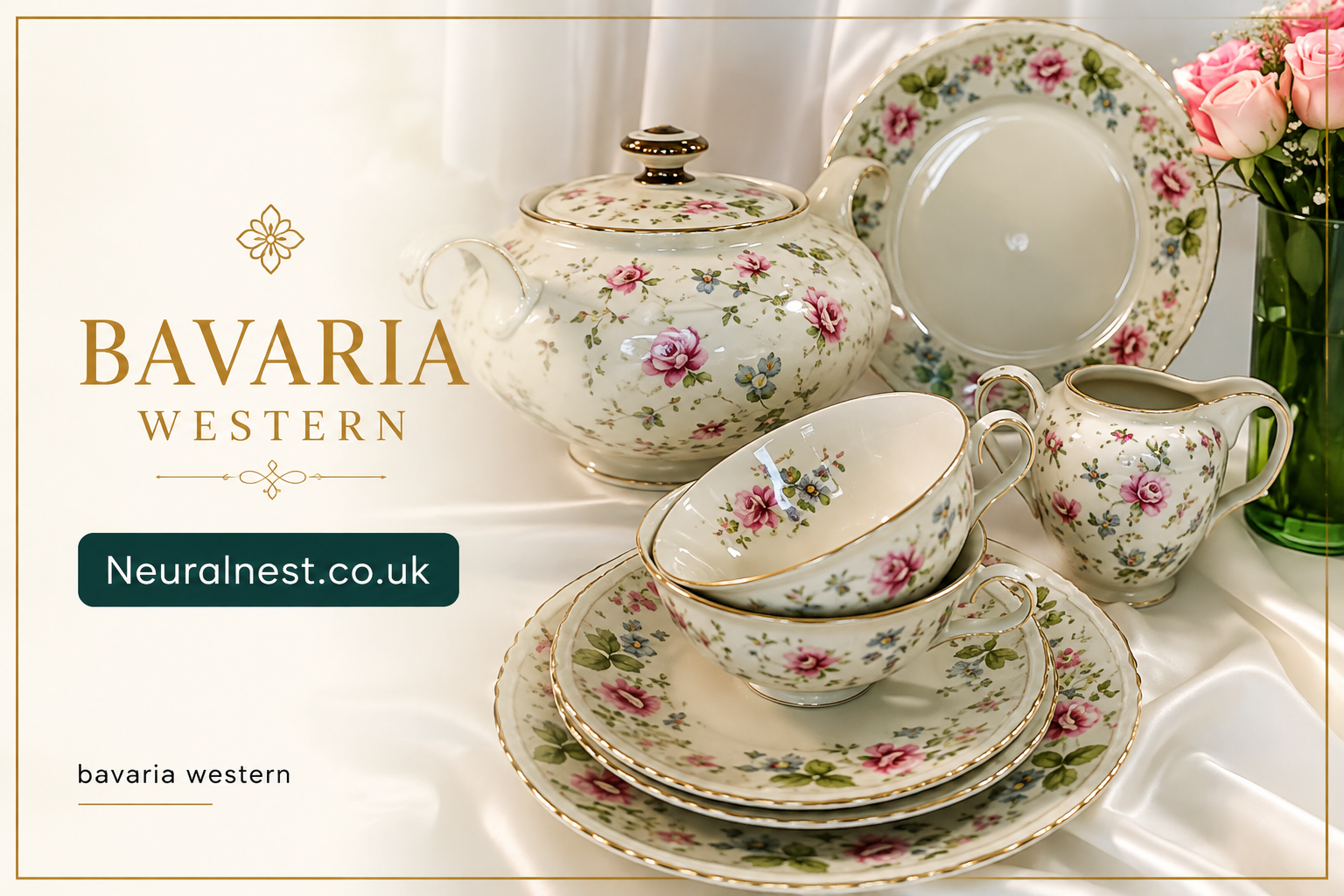
Tea sets carry extra scrutiny because completeness and matching drives value more than for single plates. When evaluating a Bavaria Western Germany tea set, look for:
- A full, matching mark across every piece. Sets assembled later from mismatched replacements often show two different mark styles.
- Hand-painted or heavily gilt decoration. Mid-century Bavarian tea sets frequently combined transfer-printed outlines with hand-applied gold trim — a labor-intensive detail that adds value.
- Condition of the gilt rims, since gold wear from dishwashing is the single most common condition issue on these sets.
- Pattern documentation. A named, catalogable pattern (vs. a generic floral) is easier to price against comparable sales.
Mistakes to Avoid When Identifying Your Mark
- Assuming “Bavaria” alone means high value. Region isn’t quality — the maker and pattern are.
- Treating “Germany” as proof of age. As shown above, it’s the weakest dating clue of the group.
- Ignoring the manufacturer name in favor of the country line. The maker’s own mark history is usually more precise than the generic wording.
- Over-cleaning gilt trim before getting an appraisal — aggressive scrubbing can reduce value on gold-decorated pieces.
- Confusing “Western Germany” with “West Germany.” They overlap but aren’t identical windows; treat the exact wording as meaningful.
Pros and Cons of Collecting Bavaria Western Germany China
Pros
- Wide availability makes building a full set realistic and affordable.
- Solid mid-century craftsmanship from established Bavarian houses.
- The mark itself gives you a genuinely useful, checkable dating tool.
Cons
- Because so many factories used similar wording, misattribution is common.
- Values vary enormously by maker and pattern, so “Bavaria Western Germany” alone won’t tell you what it’s worth.
- Some pieces are decorator-only marks with no traceable manufacturer, limiting research options.
Expert Recommendations
- Always research the full mark, not just the country line. The country wording narrows an era; the manufacturer’s own documented mark history narrows it further.
- Cross-reference at least two sources — a specialist mark reference and a recent completed-sale listing for the same pattern — before pricing a set.
- Photograph marks in raking light to catch faint underglaze stamps that overglaze prints sometimes cover.
- Get a second opinion before selling or insuring a large set. A local appraiser or a reputable porcelain specialist can confirm maker and condition-based value beyond what the mark alone reveals.
- Keep the caveat about absent marks in mind. A missing “Western Germany” line is not evidence of a different origin; check maker-specific records instead.
Conclusion
“Bavaria Western Germany” isn’t a brand, and it isn’t a mystery once you know how to read it. It’s a two-part clue: the region where the porcelain was made, and a political label that narrows the piece to a specific, checkable window in 20th-century German history. Used correctly, that small backstamp can tell you far more about your china or tea set than its size suggests — enough to date it, research its maker, and price it with confidence instead of guesswork.
If you’ve got a piece in front of you right now, start with the mark itself: photograph it, read the exact wording, and look for a manufacturer name before you do anything else.
FAQs
What does “Bavaria Western Germany” mean on china?
It means the piece was made by a porcelain factory in the Bavaria region and exported during the divided-Germany era (1949 to roughly the early/mid-1960s for that exact wording), when manufacturers needed to distinguish Federal Republic production from East German production.
How old is china marked “Bavaria Western Germany”?
Pieces with this exact wording generally date to the 1949–1960s range, based on collector research into decorator and factory mark timelines. Later pieces from the same divided-Germany period typically shifted to “West Germany” or “W. Germany” instead.
Is Bavaria china marked “Western Germany” valuable?
Value depends far more on the manufacturer, pattern, and condition than on the country wording alone. A named maker like Rosenthal or Hutschenreuther, an intact gilt tea set, and a documented pattern all add value beyond a generic “Bavaria, Western Germany” stamp.
What’s the difference between “Western Germany” and “West Germany” marks?
Both point to the same 1949–1990 divided-Germany period, but “Western Germany” was the earlier phrasing (roughly into the early/mid-1960s), while “West Germany” and “W. Germany” became more common in later decades, especially after a 1973 court ruling encouraged clearer country-of-origin labeling.
Does “Bavaria” without a country word mean the piece is older?
Not necessarily. “Bavaria” alone tells you the region, not the date. You need an additional clue — a country line, a manufacturer’s own mark style, or a documented pattern — to date the piece reliably.
How do I know if my Bavaria china is genuinely from West Germany and not East Germany?
Check the exact wording. “Western Germany,” “West Germany,” or “W. Germany” all point to the Federal Republic. However, a plain “Germany” mark alone doesn’t rule out East German origin, since some East German factories used that same wording until the early 1970s.
In Short
- “Bavaria” identifies the region of manufacture, not the maker.
- “Western Germany” refers to the Federal Republic of Germany, which existed from 1949 to 1990, and the exact wording “Western Germany” is a fairly reliable marker for the earlier portion of that period.
- A “Western Germany” stamp conclusively places a piece in the divided-Germany export era, while a plain “Germany” mark is far less conclusive.
- Manufacturer-specific mark research (Rosenthal, Schumann, Hutschenreuther, Edelstein, and others) narrows the date far more precisely than the country wording alone.
- Value comes from maker, pattern, and condition — not from the presence of “Bavaria” or “Western Germany” by themselves.